Showing posts sorted by relevance for query "read and share". Sort by date Show all posts

Friday, December 18, 2009

Christmas Angels

If you want a Christmas book to read before and after the holiday, Christmas Angels is a strong choice. Part of the "Read and Share" Bible story series, this volume, retold by Gwen Ellis and illustrated by Steve Smallman, focuses on the role of angels in the first Christmas, the years following Jesus' birth, and even in our lives today.

The book tells how angels visited Mary, Joseph, and the shepherds at different times on or before Jesus' birth. Angels again visited Joseph to tell him to flee with Mary and Jesus to Egypt, then finally to return home after Kind Herod had died. God used the angels to share His plans with these people. "God and His angels had kept them safe."

The last page of the book explains that we don't see angels very often today, but they still watch and care for us, just like they did Mary and Joseph. It also tells that Jesus is "right next to us all the time. He is always taking care of us because He loves us the best of all."

The illustrations, consistent with this series, feature wonderful cartoon characters, loads of color and nice details. The middle of the book, the pages featuring Jesus' birth, include a large two-page pop-up illustration.

What I Like: My kids love this book. They like the pictures, the pop-up ... everything. The text is large and clear, which is nice for beginning readers. I like the unique focus. It offers a different perspective from most other children's Christmas books.

What I Dislike: The last page causes me doctrinal anxiety. It's not that I DISlike it; it just makes me a little nervous. Yes, angels are all around us and, yes, they do care for us, but only because God has instructed them to do so. I worry that some will take the text too far, elevating angels and marginalizing the God who created them and empowers them. Also, Scripture tells us that Jesus is in Heaven preparing a place for us (John 14); He is seated at the right hand of God waiting for the time of His return (Luke 22:69; Hebrews 8:1). Some might argue this proves He is not "right next to us" as this book states. God is omnipresent, and Jesus is God ... I just feel the text here walks a very fine line that may lead to confusion.

Overall Rating: Very Good.

Age Appeal: 3-7

Publisher Info: Thomas Nelson, 2007; ISBN: 1400308542; Hardback; $12.99

Buy it Now at Amazon.com for $5.55!

This book is also available as a boardbook (Thomas Nelson, 2009). Order it from Amazon.com for $6.99 or from Christianbook.com for $5.49.

Special Info: Thomas Nelson has produced a line of animated videos to accompany the "Read and Share" series. The Read and Share DVD Bible contains the highest quality Bible videos I've seen (that don't feature vegetables). There are several individual volumes, but the Christmas video corresponds to this book. It reinforces most of the content and offers additional details about Jesus' birth and Mary and Joseph's roles in fulfilling God's prophecies. I highly recommend all the videos, even if you don't have the books that accompany them. They're fantastic, and my kids LOVE them!

See our reviews of other books by author Gwen Ellis. You may also be interested in our reviews of other books featuring illustrator Steve Smallman.


Bookmark and Share

Tuesday, August 11, 2009

My Read and Rhyme Bible Storybook

Studies show young children remember rhymes better than non-rhyming text, which is why so many children's book authors attempt to tell their story in rhyme. Writing rhyme is more difficult than it might appear, however, and there's really only one comprehensive rhyming Bible available, The Rhyme Bible Storybook. That is, until now.

Released this month, there's a new rhyming Bible well worth getting excited about: My Read and Rhyme Bible Storybook by Crystal Bowman and Cindy Kenney.

Bowman is a rhyming picture book master and Kenney's work is strong enough she served as a Veggie Tales writer. There are no forced rhymes here, and the text flows smoothly while offering accurate, easy to understand stories from the Bible.

Bowman and Kenney's text sometimes goes between the lines of the actual Bible, too; for example, when Jesus washes Peter's feet:
"Then Jesus said to Peter,
'It's what I need to do.
Let me wash your dirty feet
so I can be with you.'
But Jesus wasn't talking
about the dirt outside.
He wants to wash away the sins
that we all try to hide."
In addition, each story begins with a short list of words children can learn. Each is followed by a pronunciation guide, which is especially helpful for names. For the story of creation, for example, the word list includes: buzzing, twinkle, special, holy, and blessed.

After each story, there is a short list of early reader words, plus a list of rhyming words. This is followed by questions for discussion. (Example: "How many days did it take God to make the world? Why do you think God rested on the seventh day? Can you think of times when it is good for you to rest?")

Finally, there are activity suggestions. Not all will work for every age group, but there are some nice ideas here. For example, after the story of Adam and Eve, the authors ask if the readers always obey the rules. They offer phrases like "I pick up my toys when my parents ask me to" and allow kids to answer "yes," "no," and "sometimes." There are also art projects, scrambled words, ideas for making "kindness coupons," and brainstorming sessions for what we can thank God for.

While the authors are careful not to get too graphic about adult topics, they don't shirk from some of the important but difficult stories in the Bible. For example, when Abraham sacrifices his son, God merely asks for Abraham to "give Isaac back," and when Cain kills Abel, the authors write: "He was so angry/he did something bad./He hurt his brother,/and his brother died."

In addition, My Read and Rhyme Bible Storybook goes into greater detail about Jesus' death and resurrection than most children's storybook Bibles.

The back of the book also contains a list of Bible names (for example: "David - a shepherd boy who killed the giant Goliath. p. 141"), Bible places, Bible words (like "birthright" and "leprosy"), and a scripture index for well known stories.

What I Like: Judging by the text alone, I like My Read and Rhyme Bible Storybook better than other rhyming alternatives, but there are still other factors making it a strong choice. The illustrations by Christiane Engel are delightful; they are typically rich in detail and texture, and make for interesting viewing for young children. The addition of reading or vocabulary words is also useful, as are the questions and activities at the end of each story.

I also appreciate that often-glossed over sections of the Bible (like the beatitudes and "love is patient, love is kind...") are included.

Best of all, my four year old was glued to this book. We read all 367 pages in three days because she kept saying, "Please read more!"
What I Dislike: I wish the authors had included a chapter on the book of Revelation, stressing that Jesus is coming back someday.
Overall Rating: Excellent. I'm excited to share this book with other children.
Age Appeal: According to the publisher 4 to 8, but some slightly younger children will like this, too.
Publishing Info: Tyndale, 2009; ISBN: 978-1414320168; hardback, $17.99.
Buy Now at ChristianBook.com for $14.99.
Or Buy at Amazon.com for $12.23.
Special Info: Download and read the first chapter of My Read and Rhyme Bible Storybook at the publisher's website. View the illustrator Chistiane Engel's portfolio (including samples from the book).

Bookmark and Share
>

Friday, November 5, 2010

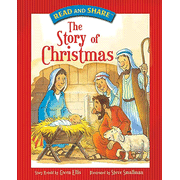
The Story of Christmas

Christmas is an exciting time for kids. Having a chance to slow down and reflect on the real meaning behind the holiday is just as important as the family, food, and presents. With The Story of Christmas by Gwen Ellis, you and your child get that chance.

Through ten bite-sized stories, your child will learn the essentials of the Christmas story: from Zechariah and Elizabeth being told they will have John, to Joseph's uncertainty over Mary's pregnancy, then to Mary, Joseph, and Jesus being sent to Egypt to be protected from Jesus from King Herod.

The book is cartoonishly illustrated by Steve Smallman.

What I Like: The stories share the essentials without going too in depth with certain details (like what it meant to be pregnant and unmarried.) They're the perfect length for bedtime.

Also, each story has the appropriate Scripture reference at the beginning so you can go to the Bible, if desired. At the end of each story, a question is asked for your child to reflect on. There's a game at the end of the book with the appropriate pictures from each tale that your child can use to retell the story to you.

What I Dislike: This is so minor I almost hesitate to mention it. Overall, I liked the the story and the illustrations, but there's just one part of the pictures that distracted me: the noses. I couldn't help but think of a carrot on a snowman's face every time I looked at the faces of the people.

Overall Rating: Excellent.

Age Appeal: 4 - 8.

Publisher Info: Thomas Nelson, Inc., 2007; ISBN: 978-1-4003-1468-3; Hardback, 24 PGS., $7.99

Buy it Now at Christianbook.com for $5.99
OR Buy it at Amazon.com for $7.99.

Special Info: This book is part of the Read and Share series, and was originally part of the Read and Share Bible, published in 2007. Also, some parents will want to know the face of baby Jesus is shown in many images.

We've also reviewed other books by Ms. Ellis, including others in the Read and Share series. You can find those reviews here.


Bookmark and Share

Sunday, September 2, 2012

A Grimm Sampler

If your family is like mine and stayed up way too late watching the Olympics, you undoubtedly noticed the commercials for the upcoming season of Grimm. There has been a huge surge of interest in the Grimm brothers' fairy tales over the last couple of years, and much of it has been targeted towards tween and young adult audiences.

In this post, I want to comment on a couple "Grimm" offerings my family has come across recently.  As always, our posts about mainstream books do not include a rating or recommendation, but are written simply to help families be more informed, since it's not always possible to read every book your child brings home.

My eleven-year-old daughter was asked to read A Tale Dark and Grimm for a public library Tween book club.  The front cover and book jacket looked a bit alarming, so she asked if I would read it first.  The story, by Adam Gidwitz, centers on Hansel and Gretel. The book is based on actual fairy tales by the brothers Grimm, and is loosely organized into a chronology of their adventures. In most of the tales, the adults can't be trusted, so Hansel and Gretel must rely on their own strength, cunning and sense of right and wrong to overcome evil and eventually return home.

The tales are quite bloody. Gidwitz doesn't shy away from describing gory deaths or dismemberment, although he is an overt narrator, and often pauses in the middle of the action to suggest readers send little children out of the room, or get a babysitter, before things get worse. At one point, Gretel has to cut off one of her own fingers to use as a key, and in another story, Hansel becomes an animal because he has killed so many other animals. In yet another story, Hansel must journey to Hell to rescue someone, and ends up tricking Satan into ferrying the dead across the river for several centuries. 

Several of the stories are reminiscent of old-fashioned "cautionary" tales. "Lips Red as Blood" serves as a helpful allegory to introduce the ideas of sexual predators and sexual assault to readers.  Plot Spoilers Ahead:  In this chapter, Gretel is unequivocally the heroine, when she tells the townspeople the young man they thought was so charming is really stealing the souls (represented as doves) of young girls and putting them in cages.  By telling, she releases the doves back to the young girls, and saves them. However, in yet another grim development, the young man is promptly killed.

At the end of the book, we learn Hansel and Gretel's father, the king, has been turning into a dragon and terrorizing his own people. Although the children figure it out, the king doesn't realize what he is doing and has no recollection of events occurring when he is in dragon form. This story could be helpful to read with children who have a parent or loved one who deals with serious mental illness. Even though the king and queen were not perfect parents, the book ends with a powerful message about forgiveness and redemption, and shows children can forgive and live well, even if they are young.

The Grimm Legacy, by Polly Shulman, was the first "Grimm" book my daughter and I read, and my favorite. In it, several teens work for a lending library full of artifacts from the Grimm tales. The teens realize the artifacts still work, and quickly become involved in a race between the librarians who want to keep the artifacts safe, and evil forces who want to use the artifacts for power. The book will make you excited about libraries, and the story is suspenseful, dramatic, and clever without being gory or disturbing. Unfortunately, there is some unnecessary "making out" between characters who don't know each other very well, which makes it not the best choice for the younger tween set.

I also read the first two books in Michael Buckley's The Sisters Grimm series. The Fairy Tale Detectives and The Unusual Suspects are funny, and more appropriate for younger readers. The author's characterization of the two sisters is so realistic--they love each other and would do anything for family, but they squabble and deal with typical sibling rivalry. The biggest concern with these books is that the line between good and evil is confusing and indistinct. Is Prince Charming really charming, or is he a manipulative business man? Why is the Big Bad Wolf the girls' protector? The three little pigs are police deputies, but are they on the right or wrong side? And is the Pied Piper of Hamlin a benevolent school principal, or is he involved in a sinister plot to exploit children for profit? You would have to read more than the first two books to get definitive answers to many of these questions. 

Age Appeal:  A Tale Dark and Grimm  12 and up due to blood and gore; The Grimm Legacy 14 and up due to romantic elements, otherwise fine for younger readers; The Sisters Grimm 8 and up


Publisher Info: A Tale Dark and Grimm:  Puffin, 2011; ISBN: 978-0142419670 ; Paperback, 256 pages, $6.99

Buy A Tale Dark Grimm at Amazon.com for $6.99

Buy The Grimm Legacy at Amazon for $7.99 

Buy The Sisters Grimm: Fairy Tale Detectives at Amazon for $6.95
 

Bookmark and Share

Tuesday, July 24, 2012

Read and Share Bible

The Read and Share Bible contains 208 well loved Bible stories retold by Gwen Ellis just for children. Each story is very simply stated, but the important facts are there so that children can understand what they are reading. The stories are in chronological order, and have a lesson at the end to make children apply what they have read:

"One evening God came to visit Adam and Eve. But they were hiding. When God found them, He asked, "What have you done?" Adam told God everything. God was sad. Because they had disobeyed God, Adam and Eve had to leave the beautiful garden. When they were outside of the garden, Adam and Eve had to work very hard to grow food.

It makes God very sad when we disobey. It makes our parents sad too."

The illustrations rendered by Steve Smallman are very colorful and eye catching. There are generally two illustrations for each story.

What I Like: It makes this mama's heart glad when my children are hungering after God's Word. This Bible story book is in chronological order, and I encourage my daughter to read it that way. She likes to come to me and discuss what she has read, and if I need to go into more detail about the story, it is easy to do so with the handy Scripture references included with each story.

What I Dislike: The only thing that bothers me about this book are the big noses on the Biblical characters. It definitely catches a child's attention, but to me is unnecessary and a little clownish.

Overall Rating: Very Good


Age Appeal: 4-8, but I think that 3-6 year old children would benefit the most from this book.

Publisher Info: Tommy Nelson, 2007; ISBN:1400308534 ; Hardcover, 440 PGS., $16.99.

Buy it Now at Christianbook.com for $10.99.

OR Buy it at Amazon.com for $11.55.

Special Info: There are pictures of Jesus in this book.


Bookmark and Share

Friday, June 1, 2012

Mainstream Series Highlight: The Mother-Daughter Book Club

If you and your daughter are looking for a fun summer read, Heather Vogel Frederick's series The Mother-Daughter Book Club is worth checking out. The series begins when four moms, chatting after yoga, decide they should start a book club and read Little Women with their sixth-grade daughters. The girls have a mixed reaction, but their mothers have already decided they will participate. The moms plan to take the school year to read the book, allowing the girls ample time to read each segment.  Part of each of the girls' lives loosely parallels the book they are studying.

Vogel writes each chapter from a different girls' perspective.  The chapters are in first-person point of view, and it doesn't take long to recognize each girl's distinct voice.  Emma is a bookworm, and she and her mom are quite close.  However, their family doesn't have much money and she feels embarrassed wearing hand-me-downs to school.  Megan and Emma used to be friends in elementary school, but Megan would rather spend time shopping, creating fashion designs and enjoying her new, more affluent friends. Cassidy is having a hard time adjusting to life in Concord, instead of California. She and her mother and sister moved after her dad died. She'd rather be playing hockey than reading, but her super-model mother is glad there isn't a girls' hockey team in Concord.  Jess is sweet, but lives on a farm and comes to school smelling like goats. It doesn't help that she is a couple of grades above the other girls in math and science.

The book club deals with typical tween girl struggles, including misunderstandings between friends, bullies at school, crushes on boys and trouble with parents. We spend lots of time at school, home, and in the community, but we also get to sit on on the book club meetings. Vogel always works in interesting handouts about the author being studied, as well. The book club often takes trips together, and we usually get to see some of the history surrounding the featured author. 

Each book in the series takes place in the subsequent year, so in book two, Much Ado about Anne,  the girls are in seventh grade and read Anne of Green Gables. In Dear Pen Pal, (book three) they read Daddy Long-Legs . They read Pride and Prejudice in book four, Pies and Prejudice.  By book five, Home for the Holidays, the girls are in tenth grade and reading the entire Betsy-Tacy Series.

Each chapter begins with a relevant quote from the classic book the club is reading, and each book ends with a thoughtful, interesting discussion guide for real book clubs reading Frederick's book.  


What I Like:  I love this series!  Of course, being a mom of daughters and an English teacher, how could I  not love a series combining tween/teen life and reading classics?

Frederick does such a great job capturing all the girl drama of tweens and teens, but showing the girls positive ways to resolve differences and misunderstandings. I also love the fact the moms are intelligent, caring and quirky, but realistic. Some of the girls are close to their moms, but some of the mother-daughter pairs deal with conflict and embarrassment.  However, it is clear the moms love their daughters regardless of  the difficulties in their relationships. 

Frederick also writes about boys in a positive, age-appropriate manner. In the first book, a couple of the girls have crushes on boys, but it is the beginning of ninth grade before the first book club member gets her first kiss.  By tenth grade, a couple of the girls have boyfriends and kissing and hand-holding are mentioned here and there.  The boys in the relationships are kind and respectful, and the kissing is innocent--accompanied by beating hearts and blushing, but "PDA" (public displays of affection) and one-on-one dating are generally discouraged.  I appreciate the girls' "BFBB" pact ("Best Friends Before Boyfriends"), and the examples Vogel includes of how the pact works.   

I also like the way the moms (and dads) handle consequences in the books.  Sometimes, the girls play pranks or are mean to each other, but they are always disciplined when things get out of hand.  

What I Dislike:  Nothing, but these aren't the books to read if you are hoping your teens will wait to kiss until after high school or later. The kissing, while not emphasized, is sweet and romantic, and definitely portrayed in a positive light. 

Age Appeal:  Publisher lists 9 and up, but the books would work best for readers the same age as the book club members in each book (so book one, sixth grade, book 3 eighth grade, etc. . .) due to the dating relationships.
 
Publisher Info: Simon and Schuster, 2007 (book one); ISBN: 978-1-4169-7-79-8; paperback, 237 pages, $6.99

Buy it Now at Christianbook.com for $5.99
 
OR Buy it at Amazon.com for $6.99.

Special Note:  Book 6, Wish You Were Eyre is scheduled to be published in September of this year.

The Kindle edition of book two, Much Ado About Anne, had consistent, distracting problems with capitalization, but the rest of the Kindle editions were fine.   

Also, the books were best if you have read the classic being studied, but are enjoyable without reading the book club book, as well.


Bookmark and Share

Thursday, April 12, 2007

Top 15 Favorite Books of Christine's Children


It’s been a while since my children were little (the youngest is now 12!), but I remember the stories we used to read to them. We had tons of books in the house because my husband and I both love to read and we wanted to pass on that desire to our children. However, we weren’t reading Christian children’s picture books in our home at that time, so this list doesn’t include any Christian literature. But, many of the books, like the Berenstain Bears and Little Critter series, taught family and social values.

My children were great fans of the Berenstain Bear books, written and illustrated by Jan and Stan Berenstain. My youngest still reads them. I think we owned a copy of every book that was written while they were little (we still have every copy, too!) In The Berenstain Bears Count Their Blessings, the Bear children, Brother and Sister, complain every time their friends and cousins get something new and they don’t. They can’t see how blessed they already have. You know how that goes! During a scary thunderstorm, Brother and Sister Bear learn that their home, and the love of their parents, is worth more than anything in this world.

The Berenstain Bears and Too Much Vacation, tells the story of the Berenstain Bears on a disasterous vacation. Their cabin roof leaks, their boat won’t float, and the mosquitoes are big enough to carry them away. But, they take photos of everything that goes wrong, anyway. After the photos are developed, they laugh themselves silly enjoying the worst vacation they ever had! My kids loved this book as the vacation scenes are hilarious. Jan and Stan Berenstain made the camera a very prominent and very funny part of this story. We read this delightful book many, many times!

In The Berenstain Bears and too Much TV, Mama Bear decides her family spends way too much time in front of the TV. She declares the TV off limits for one week. At first, Brother, Sister and Papa Bear gripe and complain because there’s nothing else to do. But, Brother rediscovers his love for soccer, Sister gets great pleasure from riding her bike, and Papa rediscovers fishing. They have so much fun without the TV, when Mama says they can watch it again, they don’t even want to! This is a great book for teaching children there is more to life than watching TV. Even though my children were great fans of TV (and still are), they enjoyed reading this book and having it read to them.

Mama Bears becomes frustrated with her family’s manners, or lack of them, in The Berenstain Bears Forget Their Manners. She comes up with a Politeness Plan – a chart listing a chore for each act of rudeness. The whole Bear family learns how to treat each other politely (and some extra chores get done in the process). Basic etiquette is presented in an easy-to-teach manner.

My children were also great fans of the Little Critter books by Mercer Mayer. One of them was Just Me & My Dad. Little Critter goes on a camping trip with his dad. Little Critter tries to help, but he keeps making mistakes. Somehow, father and son manage to put up a tent and catch enough fish to eat for dinner. This is a great book for illustrating the special relationship that exists between fathers and sons and was one of my son’s favorite books.

I Just Forgot, also by Mercer Mayer, was another favorite Little Critter book. Little Critter, like most youngsters, has a hard time remembering what he has to do. He remembers to take his raincoat when it rains, but he forgets to wear his boots. He remembers to take a bath, but he forgets to use soap! He manages to get to school on time but forgets to take his lunch with him. He tries so hard, but he finds it difficult to remember everything. My children, like every child, could relate to a character like Little Critter.

Dr. Seuss was (and still is) another one of our favorite writers. We still own lots of his books. We (my husband and I) used to dread it when the kids asked us to read Fox in Socks, though. If you’ve ever tried reading it out loud, you’ll know why. It is filled with some murderous, but hilarious, tongue twisters. If you can get through this book, I guarantee your children will love it, like mine did!

Another Dr. Seuss favorite, The Cat in the Hat, was read many times over at our house. The famous Cat in the Hat causes troubles for Dick and Sally, as they are stuck inside on a rainy day. Dr. Seuss makes the story memorable with his outrageous characters and rhyming text. This is another one of those books that was read over and over again!

The Butter Battle Book (another by Dr. Seuss) tells the story of the battle between the Yooks, who eat their bread with the butter side up, and the Yooks, who dare to eat their bread with the butter side down. A border dispute between the two groups turns into a one-up-man-ship contest over which side can come up with the craziest and most expensive weapon. Dr. Seuss delights with his usual assortment of zany characters and contraptions, while emphasizing how silly it is to fight over such trivial things.

The classic tale, Where the Wild Things Are, written and illustrated by Maurice Sendak, became another favorite. The main character, Max, puts on a wolf suit and causes trouble in his house. He is sent to bed, angry, without any supper. In his imagination, his room is transformed into a forest, where Max can act out his anger and frustrations without getting into more trouble. Although he goes on a wild adventure, he learns that home isn’t such a bad place to be.

In One Kitten for Kim, written by Adelaide Holl and illustrated by Don Madden, Kim’s cat has seven kittens. He is allowed to keep one kitten but must give the rest of them away. He loads them into a wagon and goes around the neighborhood giving the kittens to friends and neighbors. Only trouble is, instead of just giving the kittens away, he trades them for other animals. He ends up with two goldfish, a parrot, a puppy, a rooster, and a lizard! My daughter loved this book as she always wanted to keep every small animal she ever saw!

So Sick, written by Harriet Ziefert and illustrated by Carol Nicklaus, is an easy-to-read book with three short chapters. In the first chapter, Lewis is “so sick” he goes to bed to take a nap. In Chapter Two he feels better and plays doctor with his friend, Angel. In the last chapter, during snack time, Angel eats too many cookies and then feels “so sick.” This was one of my daughter’s favorite books to read “by herself.” I think she had it memorized in a very short time!

If you’ve ever read the book, Corduroy, written and illustrated by Don Freeman, you’ll know why my children loved this story. Corduroy is a stuffed bear in a big department store. He stands on a shelf all day, watching shoppers go by. One day, a little girl finds him and tells her mother, “That’s the very bear I’ve always wanted.” Her mother doesn’t let her buy it. Corduroy “wakes up” that night after the store is closed, climbs down from his display shelf, and wanders around the store, thinking it’s a big palace. The security guard finds him and puts him back on the shelf. The next day, the little girl comes back to the store, pays for him and takes him home. Corduroy finally gets the home he "knew he always wanted."

Stellaluna, written and illustrated by Janell Cannon, was another one of my daughter’s favorite books. Stellaluna is a beautiful story of a baby fruit bat who gets knocked out her mother’s embrace by an attacking owl. She lands in a bird’s nest, where she is adopted by the mother bird. Although she is well-cared for, her world is turned around as now she must sleep at night with her head up (instead of up-side down during the day), and she is fed insects (instead of fruit), which she strongly dislikes. When she finally learns to fly, she is reunited with her mother. Janell Cannon offers just the right blend of fact (about how bats and birds behave) and fiction.

How could I leave out Curious George? Curious George was a favorite of mine when I was little. I was so glad to be able to share the adventures of this funny little monkey with my children. Curious George Goes to the Circus, by Margaret and H. A. Rey, was just one of his many adventures. Of course, Curious George gets in trouble at the circus, going behind the curtains, climbing ropes, etc. But, The Man in the Yellow Hat always comes to his rescue.

Monday, January 17, 2011

Mainstream Author Highlight: Suzanne Collins, The Hunger Games Trilogy

"Mainstream Author" highlights, as well as our "Mainstream" reviews are not necessarily recommendations for Christian families. Rather, as parents we recognize that many kids will read such books, with or without parental permission. Our goal is to help parents prepare for what their kids may read, offer insights into positive aspects of the books, and give tips on areas to talk to kids about. In addition, we recognize that sometimes "dark" books may be difficult to read, but can offer an excellent way for teens to think about the world we live in.

Suzanne Collins has written a powerful series detailing the horrors of war and violence and their effects on people and societies alike. The Hunger Games trilogy takes place in post-apocalyptic America, in the not-too-distant future. Each year, twenty-four children are chosen to participate in the "Hunger Games" a deadly form of Survivor. They are forced by the government to participate, in an effort to discourage rebellion. Each year, a new arena is created--some contain oceans and jungles, or live volcanoes, or poisonous food sources. The games are televised and watching is mandatory for all citizens. The games only end when one child is left alive.

When Katniss Everdeen and her friend Peeta Mellark are forced to participate, it changes their lives and their world forever. Their actions in the games set off sparks that engender chain reactions around the country. Soon, they must decide who their friends are and what side they are on. As war breaks out, their efforts to escape violence become more and more futile. Eventually they must choose to fight or face certain death.

These books contain disturbingly graphic scenes of violence, torture, and war, as well as futuristic mutated animals, bred to kill. There are also some romantic overtones in the books. Peeta has been in love with Katniss for as long as he can remember. She feels drawn to him, but is still loyal to her best friend and hunting partner, Gale. Katniss and Peeta share a bed often, for comfort and to ward off nightmares, but are not sexually intimate. There is a lot of kissing, but most of it is staged for the television audience.

Despite the disturbing themes and dark overtones, Collins' characters are people you like and care about. The more you read, the more invested in their future you become, and the harder it is to put the books down. Also, the books would be an excellent choice to begin discussions about war, violence, and post-traumatic stress syndrome. If you have time, I strongly recommend reading this series with the teens in your life. However, I would closely monitor the age and maturity level of your teens when allowing them to read the series.

For those of you who don't have time to read the books, but still want to discuss them with your teens, I've listed pros and cons surrounding specific issues, but this list does include plot spoilers.

ISSUE: Violence is rampant, both in the Hunger Games - where contestants must kill or be killed - and in the war, where people are shot, blown up and tortured.

PRO: Collins does nothing to glorify war or present it as a fun game. She also refuses to portray either characters or governments in black and white terms. She shows good people doing terrible things to survive, and neither the government in power nor the rebel forces are above killing children if it advances their cause. In this way she shows us the ambiguity of war. We also see, at the end of the day, soldiers on both sides of any conflict are simply people trying to survive.

CON: The images of violence and death are disturbing and graphic. Collins is descriptive, and I was in tears more than once while reading each of the three books.

ISSUE: While Collins never names it, many of her characters suffer from post-traumatic stress disorder.

PRO: This series could be extremely helpful for teens who either have PTSD or who have loved ones who are suffering with it. More and more American soldiers returning from the Middle East exhibit post-traumatic stress symptoms, and Collins does a good job showing us why.

CON: Many characters deal with PTSD through self-medicating with drugs and alcohol. Collins makes every effort to show characters lying in their own vomit, wasting away, and suffering because of their dependence on chemicals. Although realistic, few of Collins' characters learn any healthy coping skills.

ISSUE: Romantic situations are portrayed with a sensual tone.

PRO: Katniss' confusion about her feelings for her friend, Gale, and her fellow contestant Peeta, could help adults talk to teens about romance and physical intimacy. It is obvious kissing and sharing a bed, however staged or platonic, confuses Katniss even more.

CON: Katniss seems to rely on Gale or Peeta, but has a hard time standing on her own, or making choices without them.


What I Like About this Series: I like the way Collins unequivocally shows us how horrible violence and war are. Katniss and Peeta begin the games full of hope, but the series ends by presenting broken people with scars that will never go away.

I also like the way Collins refuses to write the predictable young adult novel with mostly happy endings. More often than not, I finished reading a chapter with a gasp or tears. In this way, Collins refuses to allow us to gloss over the horrible realities of war. These books left me thinking about their messages long after I finished reading the series.

What I Dislike: In the last chapter of book three, it feels as if Collins ran out of time or pages. She dismisses Gale with a sentence, and Peeta suddenly overcomes being psychologically programmed to kill Katniss. Collins subtly implies Katniss and Peeta consummate their relationship, and Katniss finally declares her love for him. However, these events happen too quickly, even though I was pleased the epilogue showed Peeta and Katniss with their children fifteen years later.

Age Appeal: Young Adult (14 and up), but I would say even older in many cases

Publisher Info: Scholastic, 2010; ISBN:978-0545265355; Hardcover (Box Set), 384-400 pages, $53.97

Buy it at Amazon.com for $28.88.

Special Info: At the end of book three, we learn some of the victors of the Hunger Games were routinely forced to choose between selling their bodies for sexual use, or witnessing one of their loved ones die.

Bookmark and Share

Thursday, April 28, 2011

The Beginning Reader's Bible

As the mom of a beginning reader, I know well the desire to find a Bible my child can read all by herself. That's why I was excited to discover The Beginning Reader's Bible. This volume contains excerpts from the International Children's Bible, which the publishers say has been "tested and has proven to be easy for children to read." But unlike standard International Children's Bibles, the entire text of the Bible is not included and large, gorgeous illustrations by Marijke ten Cate are heavily featured.

In this book, children can read about:

Creation
Adam and Eve in the Garden of Eden
Noah and the flood
The Tower of Babel
God's promise to Abraham
Joseph and his brothers
Moses and the Pharaoh

Ruth
Hannah and her baby
David and Goliath
Nehemiah
Daniel and the lions
Jesus' birth
Jesus as a boy in the temple
Jesus teaching the people
Zacchaeus
Several of Jesus' miracles
The parable of the wayward son
Jesus on the cross
Jesus' resurrection
Jesus' assent into Heaven
The coming of the Holy Spirit
Saul's conversion
"A peek into Heaven" (from Revelation)

In addition, there are special pages for the 10 Commandments, Psalm 23, a few verses from Proverbs, Mary's song, the Lord's Prayer, a Bible reading chart with places to check off once each story is read, a list of the 12 apostles and the 12 tribes of Israel, the lyrics to "Jesus Loves Me" and "Jesus Loves the Little Children, plus a list of all the books of the Bible, a memory verse chart, and a sample prayer of salvation. Throughout the book, small sidebars with memory verses and activity ideas are found.

What I Like:
First and foremost, this is a really lovely looking book. The illustrations are full of deep, Mediterranean-style colors and people who actually look like they could be from the Holy Land. Artist Marijke ten Cate did a phenomenal job. My 5-year-old also enjoyed having me read this book to her; she - a beginning reader - cannot read them herself.
What I Dislike: This is not truly a book for "beginning readers." The type is small - normal-sized for an adult book - and the vocabulary is pretty tough for a true beginner. If your child reads quite well, but still wants lots of pictures in his or her book, this would be a good choice. Otherwise, consider this a read-to-me Bible storybook.

In addition, I was also surprised by certain passages in this book. For example, in the Old Testament story of Joseph, we read: "After some time the wife of Joseph's master began to desire Joseph." Later, in the New Testament, Mary is described as a "virgin." I'm don't think most kids in the beginning reader phase are ready to learn about adultery and virginity.

Some stories are also abruptly cut short. For example, at one point, Noami tells Ruth that Boaz is a relative and "will take care of us." The next sentence is "So Boas took Ruth and married her." This is probably a way to avoid difficult passages, but it shows the weakness of using a Bible translation for what is more like a storybook Bible than a true Bible.

Overall Rating: Despite these drawbacks, however, I think this is a lovely storybook Bible for grade schoolers - even if it turns out to be a read-to-me book. I give it a rating of Very Good.
Age Appeal: According to the publisher 4 to 8 - but the reading level is most appropriate for age 8 and above.
Publishing Info: Thomas Nelson, 2011; ISBN: 978-1400317028; hardback, 192 pgs., $19.99.

Buy Now at Amazon.com for $13.59

Or buy at ChristianBook.com for $13.49


Bookmark and Share

Tuesday, June 7, 2011

You Were Made to Make a Difference

If you are looking for a positive, uplifting and challenging book to encourage teens to be their best for God, You Were Made to Make a Difference would be an excellent choice. Father-daughter team Max and Jenna Lucado speak to teens who love Jesus and are ready to take the next step.

The Lucados encourage teens to be who God made them, and inspire teens to reach out and share Jesus' love with the world. Each chapter includes biblical teaching, personal testimonies from Jenna and Max, real-life stories of teens making a difference, space for readers to record their thoughts, and practical suggestions for action teens can take. The chapters close with a passage from the Bible and a prayer. The book would be perfect for youth groups or teen small groups to read together. It would also work well for families to read together.

The focus of the book is on meeting the needs of those around us, as Jesus did. The book begins by looking at ways to reach out to family, friends, and schoolmates, and moves on to look at ways teens have influenced the world. The chapter, "Stand up for the Have-Nots," highlights organizations such as Heifer International, which fights global hunger; Do Something: Teens for Jeans,which sent jeans to people in Haiti and "Loose Change to Loosen Chains"(LC2LC) which fights slavery around the world.

The end of the book includes a four-page list of ways teens can help various people, starting with daily random acts of kindness. The Lucados also invite teens to sit down with their family members and discuss ways they can change the world together.

What I Like: This book does an excellent job of treating teens as intelligent, capable people who really can make a difference in the lives of others. The plethora of examples used throughout the book is truly inspiring. Time and again, Max and Jenna show us ordinary teens who acted on a simple idea, and achieved extraordinary results.

I also like the way Max and Jenna constantly remind readers of the gospel. We learn, without a shadow of a doubt, in order to truly change lives, we must first rely on the power of Jesus Christ.

Max and Jenna use a conversational tone, and write about relevant issues in teens' lives. They use lots of factual quotes and highlights to support their ideas. End notes with references are included at the back of the book.

What I Dislike: It took me a little bit to get used to the format of the book. Chapters have lots of charts, quotes, text boxes and lists scattered throughout. The chapters are long and don't have clear breaks. It worked best for me to read the entire chapter at once, and think about it the rest of the week.

The sections where Max and Jenna speak directly are clearly marked, but it isn't obvious who wrote the rest of each chapter.

Overall Rating: Excellent (despite above remarks). I just wouldn't plan to use it as a daily devotional.

Age Appeal: 12 and up

Publisher Info: Thomas Nelson, 2010; ISBN: 978-1-4003-1600-7; Paperback, 209 pages, $14.99

Buy it Now at Christianbook.com for $9.99

OR Buy it at Amazon.com for $10.19.

Special Note: Read our reviews of other books by Max Lucado or Jenna Lucado here.

This book is based on Max Lucado's adult book, Outlive Your Life: You Were Made to Make a Difference. There are also several adult study guides, a DVD series and worship CDs available to complement the book.


Bookmark and Share

Tuesday, May 4, 2010

The Lion Book of Prayers to Read and Know

The Lion Book of Prayers to Read and Know is a brightly illustrated volume of simple prayers for various occasions. The book includes prayers of praise, thanksgiving, and forgiveness, as well as sections on "choosing the right way," "praying for one another," "praying for the world," "praying as Jesus taught," and "blessings." The prayers are a mix of biblical paraphrases, original prayers by the author, Sophie Piper, and traditional prayers (primarily Anglican).

Each section of the book is introduced by a two-page spread offering tips and wisdom about the topic. For example, in the "Forgiving and forgiven" section, we read, "Not hitting back can end a fight," "To forgive is to begin to put things right," "Gentle words can end a quarrel," and "People who are kind and friendly make the world more fun." Each statement appears next to a text-specific illustration, featuring modern children enacting the theme of the statement.

Each section is an inclusive blend of original prayers, prayers based on biblical passages, and simplified traditional prayers. The illustrations are bright, multicultural, and engaging. Children from all over the world are shown in many aspects of daily life. (For example, walking the dog, fishing, at a picnic, in bed, etc. . . .) Children with disabilities are also included.

What I Like: I love the illustrations. They immediately caught my eye, and interested both my two-year-old and my six-year-old. They are colorful, and do a good job of illustrating the prayers. This makes it easier for younger children to grasp the place prayer has in our lives.

I also like the way the biblical passages are paraphrased. A thanksgiving prayer based on Job says,
"Dear God,
When everything is going wrong, I sometimes wonder why you let bad things happen.
But then you open my eyes to the majesty of your world, and I know once more that you are far greater than I can imagine, and I believe once more that your love and goodness will not be overcome."

I especially appreciate the theology in this book. The sections on "forgiving and being forgiven" and "choosing the right way" explain the way Jesus works in our lives is such a simple manner, but the truths Piper explains are profound. I was touched by these prayers, even though children will easily be able to apply the prayers to their own situations. Also, the prayers for others include meaningful prayers "for those who are sad and . . . grieving." The section on praying for the world gently teaches children how to pray about injustice, poverty, war and violence.

What I Dislike: Nothing

Overall Rating: Excellent

Age Appeal: Publisher lists 5-7, but all of my children like it (ages 2-9)

Publisher Info: Lion Children's, 2010; ISBN:978-0-8254-7898-7 ; Hardcover, $12.99

Buy it Now at Christianbook.com for $9.99


OR Buy it at Amazon.com for $11.04.

Special Info: Jesus is pictured a couple of times, with a white robe and blue sash, looking mostly Caucasian.


Bookmark and Share

Monday, May 9, 2011

Interview with 100 Cupboards Author N.D. Wilson

When some friends of up and coming author, N.D. Wilson's suggested I review his 100 Cupboards series, I didn't realize I would become hooked so quickly, or enjoy the books so much. The books are American fantasy, (set in Kansas), where kids learn to be brave in the face of hardship, and eventually learn to delight in who they are.

The series even changed my perspective about dandelions. Now, I can't help but smile when I see dandelions poking through my lawn, and I am happy to find places for the
dandelion bouquets my children persist in bringing me. You can read more about the series and about his other book, Leepike Ridge, in my review. In addition, Mr. Wilson graciously agreed to be interviewed by CCBR, and I am thrilled to present the interview here.

CCBR: Is there an overarching message or theme you are trying to communicate through your books?

Wilson: Well, yes and no. It depends (et cetera). I hope to communicate the message and messages that reality (the greatest and grandest of all stories) communicates. More specifically, you could say that I want kids who read my stuff to see courage, sacrifice, love, and selflessness learned and exemplified by my characters.

CCBR: How did you get started writing books for kids and young adults?

Wilson: I never outgrew them. These stories are (and always have been) my favorite kind. I got started in 5th and 6th grade and began by criticizing what I was reading to my parents. They pushed me into proposing edits and changes to whatever I was reading, and from there I started dreaming up my own stories from scratch. All through high school and college I worked on shorter pieces, focusing on creative nonfiction, sketches, short stories--that sort of thing. Once I popped out of grad school, I settled in to try to write my first novel (it was bad and rightfully ended up languishing in the trash, but it was for kids). I've always been focused on this market.


CCBR: What is your inspiration, for plot lines, and characters such as Tom (Leepike Ridge) and Henry York, Uncle Frank and Henrietta?

Wilson: Hard to say. I draw a lot on the flavor of my own childhood, and I know my imagination has been spiced by the authors I most loved growing up (Lewis and Tolkien). But beyond that, I don't know. My fevered brain spits things out...


CCBR: You don't shy away from describing dead bodies or writing scary suspense scenes. What would you say to parents who are concerned the books may be frightening for their children?

Wilson: Chesterton said that a book without evil is an evil book (or something like that). I'm not afraid of reading my kids stories from the Old Testament, and they (properly understood and without dodging) can be pretty grisly business--even the broadly read basics like David and Goliath. David said what? And then he cut Goliath's head off and held it up? Samson did what? I do include darkness and evil in my stories, but hopefully in the same way and in the same context that we see them used in those tales. Darkness is to be faced with boldness, faith, and courage. Evil is an enemy to be overcome and triumphed over.

CCBR: What is your favorite part of writing? In your experience, what is the most difficult part of writing?

Wilson: Favorite part? Finishing. The most difficult part? Finishing (at least finishing well). Discovering a story page by page and chapter by chapter until a satisfying end is wonderful, but having story grip while you're doing it, and not being able to read the rest quickly (because it hasn't been written) is agonizing. You want to blaze through to the end, but...the pages are blank. There you have it--the best and the worst.


CCBR: What were your favorite books when you were growing up?

Wilson: Narnia and Tolkien when I was a younger. The Space Trilogy (and Tolkien) as I aged. Of course, you can throw all sorts of adventure tales in as well, but those are the true foundation of my imagination.


CCBR: How does your faith influence your writing?

Wilson: My faith does a lot more than influence me. It is fundamentally who I am. I can't tell you how being male influences me, or how being human influences me either. I don't know the alternatives. I hope everything I do is an extension and outworking of my faith. The stories I tell are simply apples on an apple tree.

CCBR: I heard you are currently working on a screenplay for C.S. Lewis' The Great Divorce. Do you have anything new planned for younger readers?

Wilson: Screenplays have been fun, but I do indeed have some new stuff for young readers. I'm starting a new fantasy/adventure series this summer. The first book (The Dragon's Tooth) will be releasing on August 23. Thanks much!

CCBR: I look forward to reading your newest book, and I hope our readers enjoy it too! Thanks for sharing your time and insights with CCBR!

Bookmark and Share

Monday, February 15, 2010

Curse of the Spider King

Middle-school teacher Wayne Thomas Batson delivers another incredible, fast-paced fantasy for teens in Curse of the Spider King. Written with author, youth pastor and recording artist, Christopher Hopper, Curse of the Spider King follows the lives of seven elven lords and ladies who were abandoned as babies on Earth. Although they were adopted and raised by human parents, as they approach the age of thirteen, they begin to realize they have unusual powers. Elven sentinels were sent from their home world of Allyra to search out and protect the seven children (now teens) on Earth. The sentinels are not the only characters interested in finding the teens. The Spider King, long at war with the elves of Allyra, wants the noble elves found and killed.

The search for the teens covers Maryland, New York, North Carolina, California, France and Scotland. Each teen is introduced separately, and the race to identify the teen and explain his heritage before the Spider King's forces destroy them is always suspenseful. Each teen is given The History of Berinfell, and we read chapters of it with them. (These chapters are printed on faded gray pages, making them easier to identify.) We learn of the enmity between the spiders and the elves, and we get a glimpse into each lost teens' personality, family background and circumstances.

The sentinels must find the elven children, convince them of their heritage and persuade them to travel through a portal from Earth to Allyra, leaving their homes behind forever. The fate of the race of elves depends on the choices of the teens, and eventually they agree to help. The journey to the last open portal is marked with danger, intrigue and treachery, and the teens and their sentinels barely escape in time.

What I Like: Batson and Hopper do a great job with characterization. The teens are all different, interesting and unique, and their stories are compelling. Most readers will find at least one character to relate to, and will care about the fate of all of them. It is obvious Batson is a teacher--he writes authentic and funny characters and dialogue.

The elves serve Ellos, (the God figure), and must use his Word to defeat some of their enemies. The Word is Scripture, directly quoted, but not referenced. (For example, "Light has come into the world and darkness has not overcome it.") Some of the children have also been raised in Christian homes and Christian values are reflected.

The fantasy and adventure elements are very well-written. It is fun to read about seven different characters. Also, the shift between chapters about present-day Earth and chapters about ancient Allyra captures and holds the readers' attention.

What I Dislike: I like everything about this book. However, the title and cover make the book seem much more scary than it actually is. Although the books are filled with suspense, and I would not want to meet one of the spiders, Batson and Hopper do a good job of focusing attention and description on the children, sentinels and other positive forces. While some of the children have rough lives and there are battles and blood, they are not overly described or unnecessarily gory.

Overall Rating: Excellent!

Age Appeal: 8-12, but I would say 10 and up, due to complex plot and some battle scenes. Teenagers will also enjoy this book.

Publisher Info: Thomas Nelson, 2009; ISBN: 978-1-4003-1505-5; Hardcover, $14.99

Buy it Now at Christianbook.com for $10.99

OR Buy it at Amazon.com for $10.19.

Read our review of Wayne Thomas Batson's book, The Door Within here.


Bookmark and Share

Tuesday, March 29, 2011

The River of Time Series: Waterfall

Lisa T. Bergren's new book, Waterfall is a teen romance, set in medieval Italy. Gabi and her sister Lia are tired of spending their summers with their mom at archaeological sites. They long for a modern city, with boys. One morning, out of boredom, they decide to investigate an ancient tomb, even though they risk contaminating the site. When the girls match their hands to hand prints within the forbidden tomb, the world spins and Gabi wakes up to find herself in the middle of a sixteenth-century battle.

Gabi's jeans and tank top create almost as much of a stir as her emergence at dusk from amongst the tombs. She is quickly rescued by handsome, chivalrous warriors, who are just slightly older than she is. Of course, she is most intrigued by Lord Marcello Forelli, the probable heir to the castle and the only warrior who is already betrothed. Her fascination with Marcello, (and his with her), puts a damper on his upcoming wedding plans. However, Gabi is intent on finding Lia, and trying to blend into the world of sixteenth-century nobles. Marcello's friend Luca teaches Gabi to dance, and Gabi shows Marcello's brother, Fortino, how to treat his severe asthma.

When Gabi learns the enemy Patore clan has captured Lia, she vows to do everything she can to rescue her. Marcello and Luca help her execute a daring plan, but in the end, it is Gabi's fencing prowess and Lia's skill in archery that save the day. However, Gabi is wounded in battle, and has to be stitched up by Lia. The girls become known as the "she-wolves of Normandy," and a feast is given in their honor. Marcello tries to convince Gabi he loves her, while Lia tries to convince Gabi to return home. In the end, Gabi's decision is made for her. The doctor treating her wound poisons her, and Lia convinces Marcello to return them to the tombs. They hope they can transport Gabi to the twenty-first century and save her.

Once the girls are together, the hand prints work, and they wake up in their own world once more. Gabi is miraculously healed of poisoning and her battle wound, but her heart will not heal so easily.

In the "Interview with the author," at the end of the book, Bergren explains she decided to write Waterfall after she read the Twilight and Hunger Games series with her teen daughters. She wanted them to have "something they could hand to their friends, as well as read themselves."

What I Like: This is a fun, light read. In between battles and court intrigue, we keep wondering, "Will he express his feeling or won't he?" and "Is he going to kiss her or isn't he?" There are also some funny and believable moments when Gabi puts a dress on backwards, puzzles over how to dance, and is stressed about having to use a chamber pot.

Gabi's family does not attend church much, but she still is drawn to the idea God must have called her back to medieval Italy. After a while, she decides she needs to make the most of each day, even if she can't find Lia or her mom. She spends her time helping Lord Fortino (Marcello's older brother) deal with severe allergies and asthma, and reading Dante with him. She also proves her loyalty and bravery, by helping the Forelli clan, despite the risk to Lia, who is held captive by the Patores.

What I Dislike: First of all, there was a bit too much slang for me. Gabi says things like, "fantasizing over an Italian hottie," which will make the book seem dated before long.

Second, Marcello and Gabi's attraction seems superficial. Certainly, he is attracted to her free spirit and ability to fence, and she is drawn to his chivalrous attitude and warrior's physique. However, Gabi seems to have much more meaningful relationships with funny and helpful Luca, and Lord Fortino, who becomes a trusted friend.

While the book works well as a mainstream cross-over, and girls could give the book to non-Christian friends to read, there isn't much of a message. Gabi wonders if God called her to medieval Italy, but the only clear good she does is helping Fortino treat his asthma. Series like and The Hunger Games and Twilight make you think much more about issues like abstinence, violence and sinful nature.

Overall Rating: Good--I wish the Christian message would have been stronger, though.

Age Appeal: Young Adult (15 and up)

Publisher Info: David C. Cook, 2011; ISBN: 978-1-4347-6433-1; Paperback, 384 pages, $14.99

Buy it Now at Christianbook.com for $11.99

OR Buy it at Amazon.com for $9.99.

Special Info: There is one scene where an enemy soldier captures Gabi and begins to untie his trousers, before she is rescued. She reassures Marcello he did not arrive "too late," but only narrowly missed being sexually assaulted.

Bookmark and Share