Showing posts sorted by date for query Bibles. Sort by relevance Show all posts

Monday, February 15, 2016

Big Dreams Big Prayers Bible for Kids

-->
The Big Dreams, Big Prayers Bible for Kids is a hardcover New International Version of the Bible designed for use by children 8-12 years old.  Children in this age group often have difficulty connecting with God's Word because they don't comprehend what they are reading.  The highlighted verses in this Bible as well as the easy-to-read NIV version of the Bible will help with understanding.

This complete NIV text contains several features that will be appealing to this pre-teen group:
1. a reading plan to assist them as they read through the Bible;
2. Introductions before each book of the Bible with details about the book to help them understand;
3. prayer journaling pages with verses to help with their prayer life.


What I Like: This Bible is the perfect edition to bridge your child from Bible picture books to adult Bibles.  I like that it is a complete edition of the Bible.
 
What I Dislike: There was nothing that I disliked

 
Overall Rating: Very Good
 
Age Appeal: 8-12 years old
 
Publisher Info: Zondervan, 2016; 0310744237; Hardcover, 1,344 pgs., $19.99

Buy it Now at Christianbook.com for $19.99
 
Or Buy it at Amazon.com for $23.02.


Monday, February 8, 2016

The Play- Along Bible

My almost four-year-old daughter Ella loved the Play-Along Bible by Bob Hartman!  


Before we even had a chance to read it to her, my daughter loved looking at it on her own during her "nap" time in her bed. The colorful and kid-friendly illustrations by Susie Poole invited her into this hardcover storybook. There were 50 carefully chosen stories from both the Old and New Testament that each had a beautiful drawing to accompany it.

At bedtime, my husband always reads to my daughter. She has several different Bibles and devotionals that we have used. What was different about this book was the multi-sensory approach.  Each story had motions that the parent models as they are reading to encourage the child to participate with during the story. 


For example, while reading the story of Noah, in parentheses the book guides the parent by telling them when to encourage the child to make motions. They suggest the reader make animal noises, slap their hands on their legs to mimic the sound of the rain coming down, pretend they are hammering like Noah building the ark and more!

 
What I Like: I like how this Bible storybook will hit more than one of your child's senses when reading this book. Not all children learn the same. Some are visual learners and will learn best through looking at the pictures. Some are auditory learners and will learn best through hearing the story read to them. These two types of learners can have their needs met through most Bible storybooks. I liked how this Bible storybook meets the needs of the kinaesthetic learner who learns best through movement. These learners are often left out with traditional storybooks. This book would not disappoint. It is a great way to enhance a child's understanding of God's Word at a young age.
 
What I Dislike:  Nothing
 
Overall Rating: Excellent
 
Age Appeal: 3-6 years old
 
Publisher Info: Tyndale Kids,  2015;  ISBN: 978-1-4964-0864-8 ; Hardcover, 104 pgs.,  $12.99

Buy it Now at ChristianBook.com for $10.99
OR Buy it  at Amazon for $12.99


Thursday, September 17, 2015

NIV Bible For Teen Girls

The NIV Bible for Teen Girls, designed specifically for girls ages 13 to 18, is for real teenage girls with real lives. Packed with daily readings, highlighted promises of God, challenging insights, smart advice, and open discussion about the realities of life, this Bible is designed to help teen girls grow in faith, hope, and love. The NIV Bible for Teen Girls is as sincere about your walk with God as you are, helping you discover his will for all areas of your life, including relating to your family, dealing with friends, work, sports, guys, and so much more.

Features include:
Daily readings for teen girls by popular Christian female authors (Annie Downs, Bekah Hamrick Martin, Christine Caine, Crystal Kirgiss, Bethany Hamilton, Nicole Weider, Elsa Kok Colopy, Denise Van Eck and more)
Character profiles of women in the Bible
Book introductions for each book of the Bible
Highlighted promises of God: verses worth remembering
A concordance for help in finding verses
The complete text of the bestselling New International Version (NIV) of the Bible

What I Like: Everything. This a great bible for teen girls. While this study bible is packed with lots of great features I loved the highlighted promises of God (highlighted in pink) and the character profiles of women of the bible. My absolute favorite feature is the Daily Reading by influential Christian authors.  It's unique to teen bibles, but more than that, its like these influential women are talking directly to teen girls and offering them wisdom that's easy for them to comprehend when scripture may be unclear to them.

For example, Bethany Hamilton (Soul Surfer Movie, Rise Above Book) sheds some light on Psalm 19:14 where she asks if we speak differently depending upon the crowd we are with (pastors, parents, friends). She goes on to say how God is always listening and that a mouth check-up may be in order. This teen bible is filled with these Growing in Faith, Hope and Love readings.

What I Dislike: The concordance text is very, very small.

Overall Rating: Excellent

Age Appeal: 14-18

Publisher Info: Zondervan, 2015; ISBN: 978-0310749691; Hardcover, 1728 pgs., $29.99

Buy it Now at Christianbook.com for $18.99


OR Buy it at Amazon.com for $22.66


Tuesday, March 4, 2014

Mrs. Rosey Posey and the Hidden Treasure

Mrs. Rosey Posey is a woman every child in the neighborhood loves, in Robin Jones Gunn's Level 2 "I Can Read" book Mrs. Rosey Posey and the Hidden Treasure. The kids often come over to play; one day, Mrs. Rosey Posey, dressed like a pirate, brings them a treasure map. The children have been playing pirates in her tree house and are thrilled to add a treasure hunt to their game. They follow the map and various clues until they find a treasure chest - filled with Bibles and candy.

"You found the greatest treasure," Mrs. Rosey Posey says. "Did you know that God's Word is worth more than gold and is sweeter than honey?" She explains the Bible is full of adventure: "There are stories about giants and king and talking donkeys...Every word is true." The children beg her to read her a story from the Bible - and she does.

What I Like: If your child likes playing pirates or enjoys treasure hunts, this is a perfect book for him or her. I love how the author makes the Bible seem so fun while teaching a deep truth - that there is no treasure greater than God's word.

What I Dislike: Nothing.

Overall Rating: Excellent.

Age Appeal: about 5 - 8

Publishing Info: Zondervan, 2009; ISBN:  9780310868903; ebook, 32 pgs., $1.99

Buy the Kindle version for $1.99
Or buy the ebook at ChristianBook.com for $1.99


Friday, January 31, 2014

The Best Bibles for Early Readers

It's never too early to instill the habit of daily Bible reading in your child. That's why, as soon as my daughter could read even a little bit, I was eager to find her a Bible she could read on her own. Yes, I still read both a "real" Bible and a good storybook Bible to her, but she has always taken delight and pride in having a Bible she can read herself.

Sadly, though, it isn't all that easy to find Bibles designed for young children or early readers. I've looked at all of them that are currently in print - and this post will, I hope, help you wade through them much more easily, discovering which one is right for your child.

NOTE: The term "early reader" is vaguely applied in the publishing industry, but for our purposes, it means any book designed for children who are still learning to read independently. Often, such books are labeled "I Can Read" with the level of difficulty (1, 2, and 3) suggested on the cover. In this post, I am not referring to NIrV Bibles, which are often marketed as "early reader" Bibles, but which require a greater level of proficiency to read than leveled readers.

The Hear-Me-Read Bible by Dr. Mary Manz Simon

I believe this is currently the best Bible storybook for children who are just beginning to learn to read. The stories are short, there are only a few sentences per page; and the illustrations are vivid and interesting. If your child can't yet read level 1 early readers without help, The Hear-Me-Read Bible is an excellent choice. (Read our complete review here.)


My Read and Rhyme Bible Storybook by Crystal Bowman and Cindy Kenney

This is a rhyming storybook Bible. Each chapter begins with a word list, and after each story, there's another short list of words, plus a list of rhyming words. This is followed by questions for discussion. There are many things to love about this Bible. The writing is very good and the illustrations are cute. (In fact, this is my non-reading son's favorite Bible.) But I don't find it a very good early reader's Bible. I'd say it's about a low level 3 in it's reading difficulty - and by the time children are reading that well, they may object to the word lists and can probably read a more challenging Bible. (Read our complete review here.)


The Young Reader's Bible by Bonnie Bruno and Carol Reinsma

My daughter, who is just barely reading at Level 2, reads this Bible storybook daily. She needs some help with it, but not so much she becomes frustrated.  The stories are in big type, are short, and have attractive illustrations. Sadly, I was recently informed this book is going out of print - but you can still find copies at Amazon.


The Early Reader's Bible by V. Gilbert Beers

This one is very similar to The Young Reader's Bible. The stories are short, told in larger-than-average type, and accompanied by attractive illustrations. My daughter thinks this book is slightly harder to read than The Young Reader's Bible, but if it is, it's only slightly so. Each story ends with "Something to Ask" (questions to ask yourself) and "Something to Do" (which are sometimes just more questions, but sometimes also encourage action). If I had to choose between The Early Reader's Bible and The Young Reader's Bible, I personally would choose the latter.


My Learn to Read Bible by Tracy Harrast

If you like rebus books - that is, books that replace certain words with pictures so kids can "read" - this title may be a good choice for you. This is a large book with lots of colorful illustrations, targeted toward very young children. To use it, though, children will have to memorize what many of the pictures mean. For example, they have to understand that one image of a man is Jesus, another is a shepherd, and another just means "man." I am not a huge fan of rebus books - although they can be handy for children who are eager to read, but can't yet.


And a few Bible storybooks that look like they are for beginning readers, but are not:


The Beginner's Bible by Kelly Pulley: This is more of a read-to-me storybook Bible than a book beginning readers can read to themselves. (See our full review here.) 
The Beginning Reader's Bible with illustrations by Marijke ten Cate: Of all the Bibles I've seen marketed toward early readers, this one fails the test most miserably. The reading level is pretty high; it's excerpts from the International Children's Bible, and suitable only for children who are passed (or nearly passed) level 3 readers. In addition, some parents may object to the mature nature of some of the content. (For more information, read our complete review, here.) If your child can read this Bible storybook, I think you're better off giving him or her a complete International Children's Bible.

Read with Me Bible by Dennis G. Jones: This book isn't for early readers. It's designed to be read to toddlers. (Read our full review here.) There is also the NIrV Read with Me Bible, but again, why give your child a collection of excepts when he or she can read a complete NIrB Bible?


Monday, April 1, 2013

Gabriel

I admit, I was very pleasantly surprised by Bernina Moore’s unassuming book Gabriel. The book begins with a boy and his dad. While the boy cares for his father (Randy)—a victim of a stroke—the father asks to hold a toy truck. After our narrator gives his dad the truck, Randy talks about his childhood… and about his belief in angels.

As we revisit the past, we see Randy as a young boy, playing with the truck he now holds. Randy cherishes the toy truck, given to him by his father before he passed away, so when Bad Billy, a neighborhood bully, tries to steal it from him, Randy fights back. Unfortunately for Randy, the bully and his gang beat him pretty soundly. Fortunately, Randy is able to hold on to his precious truck. It’s at this point, after Bad Billy leaves, that Randy meets a stranger.

The stranger’s name is Gabriel, and Randy is mad at the boy for standing idly by while he got beaten. The conversation between the two is crisp and realistic:

“How long have you been standing there!’ I shouted.
“Long enough,” he replied.
“Why didn’t you help?’
“You had a good defense.”
“Balled up?”
“It worked.”
“My lip is busted!”
“It will heal.”
“My clothes are dirty!”
“Your clothes can be washed.”
“They took my cars!”
“You kept your truck.”

Gabriel’s responses—so straightforward and swift as to seem almost mysterious—intrigue Randy. When he comes across Gabriel the next day, he confronts him again, then engages him in play. The two hit it off and become friends. Again, their conversation is moves with the same quick-to-the-point fluidity.

“Are you coming back?”
“Tomorrow.”
“Maybe we can play with some of your toys tomorrow.”
“I don’t have any toys.”
“Then what do you play with?”
“I don’t.”

Moved to compassion, Randy gives Gabriel his toy truck. This puzzles Gabriel. He says, “A few days ago you took a beating for this.”

To which Randy replies, “A few days ago you weren’t my friend.”

As the story progresses, more mysteries surround Gabriel. His shadow seems distorted, as if he had wings. His home across the street is boarded up and empty, except for an older brother named Uriel. Gabriel and Uriel communicate in a language Randy doesn’t recognize. And Gabriel learns new things—like how to ride a bike—with remarkable ease.

Eventually Randy figures out that Gabriel is an angel. His angelic friend tries to explain what’s going on and takes Randy on some unbelievable trips. In the end, however, Randy discovers Gabriel’s real reason for moving in across the street: His mother is going to die.

Spoiler alert: Read no further if you do NOT want to know how the story ends!

Filled with anguish, Randy prays… and prays… and prays. God answers his prayers in a painful way. Randy suffers an injury dire enough to keep his mom home from work, which makes his mom miss dying in a four-car accident on the highway. After that, Gabriel returns Randy’s truck to him, telling him that he’s leaving. Here is another wonderful snippet of their conversation:

“Are you really leaving?”
“Yes.”
“Will I see you again?”
“Sure.”
“Will you look the same?”
“I’ll try.”
“If you don’t…how will I know it’s you?”
“I’ll make the truck ring.”

As the father finishes his tale about Gabriel, he smiles. Our narrator takes the truck from him and examines it. He presses the ringer, as he has many times before, expecting nothing to happen.

But to his surprise, it rings.

And the father dies.

What I Like: This dialogue in the story was well paced; it was some of the most enjoyable dialogue I’ve read in a children’s book. The story kept me engaged too. It was just the right length to satisfy my book appetite, but not too long to become tedious. Also, while there is much speculation about how an angel might look and behave and what role it might play on earth, the author did a nice job giving her fictional vision a realistic feel. The message is gentle and subtle; you will not find references to Scripture or Bibles stories, or even many references to God. Nonetheless, the story inspires a feeling of comfort and hope. This book is reasonably prices too!

What I Dislike: This is a minor point, but the book did contain a few punctuation errors and a mix up of the word “then” with “than”. These did not detract from the story.

Overall Rating: Excellent

Age Appeal: None is given. As a read aloud, the K-1 crowd might enjoy it (not read in one sitting). Otherwise, I'd go with 8-12.

Publisher Info: CreateSpace Independent Publishing Platform, 2012; ISBN: 978-1480121652; Paperback, 44 pgs., $4.50

This book is not available at Christianbook.com.
Buy it at Amazon.com for $4.50
OR Buy the Kindle version for ONLY $1.25!!!!


Monday, March 4, 2013

Bedtime Bible Stories: More Than 180 Faith-Building Readings for Kids Ages 5-8


Bedtime Bible Stories: More Than 180 Faith-Building Readings for Kids Ages 5-8 was jointly authored by Jane Landreth, Daniel Partner, Renae Brumbaugh, and Linda Carlblom.

The book features, as the name suggests, more than 180 stories that relate to Bible verses. Some of the stories are simple re-tellings of Bible stories, but others are stories of how particular Bible verses relate to our lives.

Each story section is two pages long. The first page has an illustration along with a Bible verse. The second page contains the story that goes along with the verse as well as what the author calls a “Prayer Starter”. It’s actually a short prayer, only a sentence or two, that can be used by itself as a simple prayer or added to by the child if they feel comfortable doing so.

With the exception of the last verse/story, all are in chronological Biblical order, starting with Genesis 1 and ending with Revelations 22. The last story in the book talks about Jesus being the King of Kings. The Biblical reference for this entry comes from the book of Luke.

The illustrations are beautifully detailed, bright, expressive and very child-friendly.

What I Like: Just about everything. This is a Bible that should appeal to young children through its attention-getting images and its simple stories. I can see it as the type of Bible children will want to read (or have it read to them) over and over.

What I Dislike: Most Bibles that are geared to kids don’t include references to the book of Revelations. As far as I can recall, this is the first one I’ve read that does so. That doesn’t necessarily mean I dislike the reference to Revelation, but I think it is very difficult to explain verses from that particular book to adults, much less to children. I think the authors did a good job of referencing the three stories from Revelation, but Revelation itself does not lend itself well to further exploration beyond the very simplest explanations.

Also, I know I’m being picky here, but the introduction to the book, called “Welcome to the Wonderful World of Bible Stories!” says: “Here are more than 180 carefully-retold Bible stories presented in biblical order…” That’s not a completely accurate statement. Actually, most of the stories are simple retellings of Bible stories, but some of them are not; they are stories that illustrate how a particular Bible verse relates to our lives. I just thought I’d point that out to potential readers who might be surprised to find that not all the stories are actual Bible story “retellings” as indicated.

Overall Rating: Very good.

Age Appeal: 5-8 years.

Publisher Info: Barbour Publishing, 2012; ISBN: 9781616268435; Hardcover, 384 pages, $19.99.


Special Info: Read our reviews of other books written by Renae Brumbaugh and Linda Carlblom.


Tuesday, January 29, 2013

English Standard Version Grow! Bible

The English Standard Version Grow! Bible is a simple, straightforward, "grown-up" Bible.  Printed in blues and browns, it would be a perfect choice for boys who need a complete Bible, but aren't ready for a study Bible yet.

Like many Bibles for the eight-to-twelve set, the Grow! Bible is full of helpful features. It includes a "WH-question" on nearly every page (who, what, when, where, why and how). Personal application notes are highlighted in the "4U" sections. "Cross Connections" in the Old and New Testaments explain how a passage relates to Christ's life, death and resurrection. The Grow! Bible also includes lots of charts, maps, articles and timelines. A glossary at the back and introductions to each book of the Bible help readers to understand biblical passages better.

The English Standard Version is a translation of the Bible that focuses on literal, word-for-word translation, instead of a thought-for-thought translation focused on modern language (like the New International Version). Many readers won't notice a difference, but it may be a good idea to check which version your church (or children's department) uses, if your child is planning to bring the Bible to church.

What I Like:  I like the helpful features. They are full of biblical and historical information, but they shy away from imagining modern scenarios. The "4U" sections may talk about principles, like sin and forgiveness, or a relatively universal experience, such as being called a name, but they leave out details. This helps readers be able to personalize the message of the Bible for their own lives.

I like the blue and brown color scheme for boys. The Bible definitely looks and feels "grown-up."

I especially like the salvation outline found right before the book of Revelation.

What I Dislike:  I wish the Bible printed the words of Jesus in red. Also, the format and cover are relatively simple, and may not appeal to boys on the younger end of the age range as much as some other Bibles on the market. However, the Grow! Bible isn't likely to be outgrown as quickly, either.

Overall Rating:  Very Good

Age Appeal: 8-12

Publisher Info: Crossway, 2001,2011; ISBN: 978-1-4335-2874-3; Hardcover, 1569 pages, $27.99

Buy it Now at Christianbook.com for $17.99
 
OR Buy it at Amazon.com for $18.47.

Special Notes: The Grow! Bible is available from the publisher in cases of twelve, at a discounted price.

Click here for CCBR reviews of other Bibles.
 

Bookmark and Share

Sunday, December 2, 2012

Chinny Chin Chins: When Faith Flies Over the Finish Line

In John Berglin’s book Chinny Chin Chins: When Faith Flies Over the Finish Line, ten-year-old Rodney Whimple is less than enthusiastic about his family’s move across country to a new state. However, soon upon their arrival, Rodney discovers his new home has a sophisticated telescope, he finds several new friends, and he embarks on a high-flying adventure… and, just like that, things don’t seem so bad anymore.

While Rodney gets to know his new friends, he encounters a mean girl named Sally Tally. Sally desperately wants to win the annual Ocean City Air Race, and she’s not above cheating to guarantee success. Rodney must avoid Sally’s sneaky spies, learn how to fly an airplane, keep his plans secret from his parents, and try to win the race himself. It won’t be easy though. When Sally shoots down Rodney's airplane during practice (and the crash leaves his plane in ruins), Rodney finds out the hard way that Sally doesn’t like to lose.

Though sized like a picture book, the story is actually a chapter book with several full-color illustrations done by the author.

What I Like: : A central character named Teensy encourages the boys to read their Bibles.

What I Dislike: To me, the characters seem flat and/or stereotyped. For example, Larry the Lump is overweight and will do any sneaky deed for a cheeseburger. The super-smart boy wears glasses. Then there’s Rodney’s first friend, a boy named Matt. Matt is the exact same age as Rodney, holds the exact same beliefs, and goes to the exact same school. For the rest of the story, those two do almost the exact same thing, even to the point of echoing each other. (For example: “Not a word,” whispered Matt./ “Yeah, not a word,” whispered Rodney; “Yesss!” Rodney cheered and he eagerly climbed into his cockpit./ ”Yesss!” Matt cheered and he eagerly climbed into his cockpit just as fast as Rodney; and so on…)

Another quirky thing is the fact that the book has two child prodigies, alike in amazing skills but one is a believer and the other is not. Likewise strange is the fact that the star prodigy (Teensy) has a long secret passageway built into his house that leads to an underground laboratory. The lab has a large castle-style portcullis for a door. An enormous green lion-headed machine (with a human-like personality) also guards it. In addition, the lab has surface access with a carrier platform that goes up and down. The setup reminds me of Dexter’s Lab.

At some point, Rodney and his move fade into the background, and the story shifts to a flying contest between a Teensy and Sally Tally. (Yes, the children build and fly their own airplanes… at ten years old.) The change in direction makes the story less cohesive to me.

Finally, I dislike how the author seems to excessively use the word “so” to describe things. (So soft… so loud…)

Overall Rating: Ho-hum

Age Appeal: None is listed, but I'd guess grades K-1. It's too lengthy for the younger audience.
Publisher Info: WestBow Press, 2012; ISBN:978-1449736309; Paperback, 64 pgs., $23.99

Buy it Now at Christianbook.com for $17.99
OR Buy it at Amazon.com for $18.71.

Thursday, September 27, 2012

Kermie: A Story about Death, Dying and Hope

Kermie: A Story about Death, Dying and Hope was written by Dr. Christine Gillan Byrne. Told in first person from a child's point of view, the book tells the story of Kermie, a beloved dog. Kermie is old and sick and won't be with the family much longer. The text explains what the child's mother has said about Kermie and what the family is doing to prepare for his death. The child shares her feelings.

The book then transitions into a section about biblical stories of death: Jarius's daughter, Lazarus, and Jesus's Resurrection. The child finds hope in knowing that Kermie will get a new, healthy body and that she will see him again in Heaven one day.

Full-color photos of Kermie, the author's dog, and the family serve as visuals throughout the book. Traditional illustrations, as found in older children's Bibles, are provided in the section about the Bible stories.

Bonus materials include a note to parents, a guide to grief in young children, blank memory pages for readers to decorate, ideas for creating memories and how to say good-bye. A "Verses to Learn" page features quotes from Revelation 21:4 and Isaiah 25:8, 9. Readers are also encouraged to discover 1 Corinthians 15 and 1 Thessalonians 4:13--18.

What I Like: This book is very well written! It presents a gentle, loving tone. I think it would be tremendously helpful for children struggling to articulate their thoughts and feelings when facing such a situation. I especially like all the bonus material provided for parents and caregivers: the memory verses, guides to helping children deal with grief, and the memory pages.

What I Dislike: The book targets families dealing with the loss of a loved one or a pet, but I feel that is too broad a focus. It's a wonderful book for those facing a beloved pet's death, but feels inadequate for handling the death of a family member. I just don't see it as the same thing.

I understand the costs of self-publishing, but feel $16 is just too high for a 28-page paperback.

Overall Rating: Very Good.

Age Appeal: 8 and under

Publisher Info: Xlibris Corporation, 2011; ISBN: 1456836153; Paperback; 28 pgs., $15.99

Buy it Now at Amazon.com for $15.99.

Special Info: This book and its author clearly assert that pets go to Heaven after they die. Not all denominations agree with this theology. If you or your church believes differently, you should consider the questions that may arise and any confusion that may be caused by conflicting doctrine.


Bookmark and Share

Friday, August 31, 2012

The New Life Bible for Boys/Girls

When your child is old enough to read a simple translation of the Bible, but still enjoys some of the illustrations a Bible storybook has to offer, The New Life Bible for Boys or The New Life Bible for Girls may be just the thing.

Both are Bibles in the New Life Version, which is designed for simplicity and widely considered the most understandable Bible translations. The boy's version features a great illustration of David and Goliath on the cover. The inside includes 12 colorful and stylized cartoonish images of various Bible heroes, including Moses, Joseph, and Paul. Alongside these images are colorful pages offering trivia, "Did You Know?" sidebars, and short explanations of heroes like Joshua, Elijah, David, Daniel, and Peter. There is also a presentation page at the beginning of the Bible.

The girl's version features a modest pink princess (not Disney-fied, thankfully) and the same inner layout, but featuring Sarah, Miriam, Deborah, Hannah, Ruth, Esther, Mary Magdalene, Lydia, and others.


What I Like: Visually, these are very attractive books. The illustrations are stunning in some cases, and certainly eye-catching. I like the trivia and other added features, and the text of the Bible itself is of a reasonable size and not printed on flimsy paper.

What I Dislike: Nothing, really, although I admit to not being a huge fan of the whole princess thing. That said, this Bible handles it very well, focusing on inner qualities, not beauty and romance.

Overall Rating: Excellent.

Age Appeal: I'd say 7 - 11 or so.

Publishing Info: Barbour Books; 2012; ISBN (boy's) 978-1616265243, (girl's) 978-1616265151; hardback, 944 pgs., $19.99.

Buy The New Life Bible for Boys at Amazon for $15.59
or The New Life Bible for Girls at Amazon for $14.99

OR

Buy The New Life Bible for Boys at ChristianBook.com for $13.99 (hardback) or $9.99 (paperback)
or The New Life Bible for Girls at ChristianBook.com for $13.99 (hardback) or $9.99 (paperback)


LinkLink

Thursday, June 28, 2012

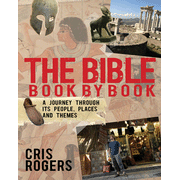
The Bible Book By Book

The Bible can be a difficult book to bring to life, especially for teens. In The Bible Book By Book by Cris Rogers, you may not get all of the answers, but you definitely have the tools at your fingertips to start the discussion.

The Bible Book By Book is a comprehensive field guide, appropriate for the curious teen, the youth group leader, or the parent leading a small group. Every book of the Bible has its own essay, usually 2 - 4 pages in length, with the following information:
  • Author
  • Date written (approximate)
  • Type of book (is it history, poetry, gospel, prophecy, etc.?)
  • Key characters (who are the significant players in the book)
  • Major themes
  • Title and Style (which gives insight to how the book got its name)
  • Background (historical context)
  • GPS (locations in the book, as well as some religious components to the region)
  • The Detail (tidbits about specific parts of the particular book. For instance, in the section on 1 Chronicles, the writer points out differences in the accounts of Solomon's crowning as king here and in 2 Kings, then goes into a bit of supposition on why the variance may have happened.)
  • Other books to read 
While this book isn't suitable for everyday reading, or for reading straight through, it is appropriate as a reference, giving historical context for every book of the Bible in an easy-to-understand way. It's not a substitute for a good concordance, but an aid to understanding the Bible's culture and backstory.

What I Like: I love the fact this book is so well organized. I knew what to expect, and it was easy to find information on whatever I was looking for, although it does lack an index. I frequently learned something new, and many things are surprising, especially about the culture of Rome and the gods/goddesses worshiped during New Testament times.

References between the New and Old Testament books provide substance to parables, as well as the nature of God, among other things. The explanations are always fascinating, and I frequently found myself reading tidbits to my husband, like how there are two versions of Jeremiah, depending on what Bible you use. The Hebrew version is in the Jewish Bibles, and is the basis for the version in the Protestant Bible. The Greek Septuagint version of Jeremiah is used in the Roman Catholic and Eastern Orthodox Bibles, which is about an eighth shorter and presented in a slightly different order.

The writer doesn't assume that the reader has read the previous entries. Frequently, information is repeated, maybe not exactly, but enough that I noticed it, especially in Paul's letters to different churches (Ephesians, Colossians, Philippians, etc.)

Photographs of the Holy Land appear nearly on every page, from its people, to the scenery, even a few maps done by the author. I really feel that it gave some significance to the Bible, not that I'd be reading about some vague idea, but a real place, with real people.

What I Dislike: First, you need to know I believe the Bible is God's Word to us and every word is true. So, when, for instance, in the part on Esther, the type of book is labeled as "comic, fictional history," I cringe. Other examples that caused me to pause included:
  • Ruth: the writer describes the book as "more like a 'soap opera' than a pure history book." 
  • 1 Chronicles is described as an "inspiring propaganda account of David" mostly because of what is missing from the book (absence of the civil wars, Bathsheba, or David murdering Bathsheba's husband.) 
  • For Jonah, it's suggested that some scholars believe Jonah didn't happen, although I got the impression the author doesn't agree with that idea. 
  • The story of Samson is believed to be folklore, rather than precise history. 
However, I think an astute reader can glean the important information, and disregard what may or may not be complete truth. Much of this may be one man's opinion, but then again, it may be backed up by scholars much more learned than me.

A novel was referenced for further reading with Judges, although there may have been others which I failed to note as I read. While the novel may be perfectly good, and filled with accurate info, I would hesitate to recommend a fictional account for someone who is shaky in their knowledge or faith since it could give them wrong impressions.

I would have liked it if, in the GPS sections, the writer would have indicated where places are now. In the New Testament sections, Mr. Rogers was a bit better about it, but it would've been nice to have it consistently done for areas that are now known by other names. More maps would've been good to assist as well.

Overall Rating: Despite everything mentioned above, I found this book to be very good. The good aspects definitely outweighed the bad.

Age Appeal: 12 and up

Publisher Info: Monarch Books, 2011; ISBN: 978-0-85721-016-6; Paperback, 204 pgs., $19.99

Buy it Now at Christianbook.com for $14.99
OR Buy it at Amazon.com for $19.99.

Special Info: The author, Cris Rogers, is a minister for the Church of England, and as such, there are frequent British spellings throughout the book.


Bookmark and Share

Friday, April 20, 2012

My Holy Bible for African-American Children


My Holy Bible for African-American Children, is as the title says, a Bible designed for African-American children. It is a King James Version with many extras.

The many extras include pages with lyrics from popular Negro spirituals, categorized Bible verses such as ones for “I am special to God”, The 10 Commandments for Children, The Lord’s Prayer, the Beatitudes, and other special pages. The book is printed in large print type for easy reading with the words of Christ in red ink.

Each book of the Bible is preceded by an Introduction to give the reader a brief history of the book as well as an outline for it. There is also an Index as well as a Concordance.

There are 32 illustrated pages throughout the book. All the people in the illustrations are African-Americans.

What I Like: Everything. The people depicted in most illustrated Bibles are light-skinned. I don’t know what it’s like to be an African-American, but I believe if I were I would appreciate a Bible of this nature.

What I Dislike: Nothing.

Overall Rating: Excellent.

Age Appeal: 7 and up.

Publisher Info: Zonderkidz, 1994; ISBN: 9780310719878; Hardcover, 1808 pages, $24.99.

Buy now at ChristianBook $16.49!

Or buy at Amazon.com $21.36.

Special Info: This Bible was designed for African-American children.


Bookmark and Share

Friday, January 6, 2012

The Story Bible

The Story Bible, edited by Edward A. Engelbrecht and Gail E. Pawlitz, presents "130 Stories of God's Love." The book includes representations from Genesis to Revelation, each in concise two- to three-page stories. Key words are highlighted in the sidebar and defined in the Glossary at the back of the book. Each story also includes application prompts.
  • ASK: One to five questions encourage readers to interact with the text. These typically ensure comprehension.
  • DO: Activities range from discussion starters to crafts, memorization and trying new foods.
  • PRAY: This provides a short prayer related to the story, typically three sentences or less.
The illustrations showcase the talents of more than ten different artists. All feature bold colors, strong contrast and realistic details. Every story boasts at least one full-page, full-color illustration.

Additional features include a Preface and Introduction that detail the thought processes that went into the creation of this Bible as well as helpful tips for parents. The introduction includes guides for development and interest as well as reading strategies. This section is divided into three parts, based on age (Read to Me = 2 to 6; Read with Me = 5 to 8; Hear Me Read = 7 to 10). The Table of Contents sorts the stories chronologically and lists them by title and chapter. Bible references are provided both in the Table of Contents and the stories themselves.

What I Like: Most children's Bibles offer paraphrases and over-simplified texts, but this one is surprisingly reflective of Scripture! My husband and I (both holding Bible degrees) viewed it as an accurate contemporary translation, only abridged and illustrated. This makes sense since the text is derived from the ESV (English Standard Version) Bible. While paraphrases have their place and are quite helpful, especially with children, publications like this one offer an invaluable bridge between children's Bibles and regular Bibles. I like that it works for families whose children span various age ranges or developmental levels. We can read it together as a family and everyone gets something from it.

I also greatly appreciate the introductory matter. There parents learn that the text for this Bible was drafted while consulting both the Flesch-Kincaid Readability Formula and the Dolch and Fry Sight Word lists, both resources highly acclaimed by literacy teachers nationwide. This translates into an approachable text for early readers.

What I Dislike: Nothing.

Overall Rating: Excellent.

Age Appeal: According to the publisher, 3 and up. The introduction, however, offers instructions for children ages 2-10.

Publisher Info: Concordia Publishing House, 2011; ISBN: 0758619022; Hardback; 480 pages; $29.99

Special Info: The face of Jesus is pictured several times in this volume, both as a child and an adult.


Bookmark and Share